FLT9100 Series of TDR Level gauge
The FLT9100 Series range of TDR products is ideal for the measurement of liquids, pastes, slurries, powders and granules to a range of 60m. The FLT9100 is latest 2-wire TDR level-measurement gauge, the gauge emits signals with a small width, large bandwidth and short signal rise and fall times.
Unaffected by pressure, temperature, viscosity, vacuum, foam, dust, changes in dielectric constant or coating of the probe, the FLT9100 Series can measure virtually any product in either Direct or TBF mode utilizing any one of its seven probe types. OPERATING PRINCIPLE
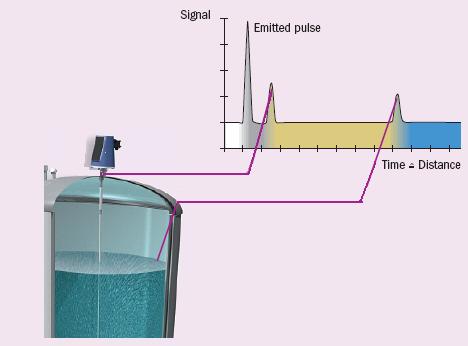
The FLT9100 Series level gauge operates on the TDR principle (Time Domain Reflectometry), subnanosecond pulses are sent along a probe guide at the velocity of light.As soon as the pulse reaches the product surface,it reflects back to the electronics.Since the velocity of lightis a uniform,fixed constant in air or gases,the FLT9100 does not requires any calibration,commissioning or maintenance. (1)Products with a dielectric constant > 1.8 These applications work in “Direct Mode”, which means that the reflection from the product surface is used directly for the measurement of the level. Two different applications are possible: a) Level Measurement The wave is reflected from the first product surface and is received by the receiver on the top of the tank. The wave travels along the conductor above the product at the speed of light and the return time of the wave pulse is directly proportional to the distance between the top of the tank and the surface of the product (level). b) Interface measurement Interface measurement can only be made if the first layer has a lower dielectric constant than the second and if the difference between the two dielectric constants is greater than 10. For measuring interface level we use the residual wave after the first reflection. This part of the wave moves further down the conductors through the first product layer until reflected on the interface level. The speed of this wave depends on the dielectric constant of the first product. This means that we have to know the dielectric () of this first layer to determine the interface level. (2)Products with a dielectric constant < 1.8r To measure the level of low dielectric products we use the Tank Bottom Following principle (TBF). The downward wave will first pass through the air at a known speed and then through the product at a speed depending on the dielectric constant of the product.Since the return in air is calibrated; the difference in the two times is directly proportional to the product level in the tank. As we are largely dependent on the dielectric constant, this method is less accurate than the direct mode method. Pulses of low power microwaves are sent along conductors. At the point where the waves meet the product surface, they are reflected by the product. The intensity of the reflection depends on the dielectric constant of the product. The higher the dielectric constant, the stronger the reflection will be, e.g. up to 80% reflection for water. The instrument measures the time between emission and reception which is proportional to the distance. THE ADVANTAGES ARE
Suitable for liquids, slurries, Pastes and solids Immune to corrosive and acidic atmospheres Suitable for all tank shapes Measurement is independent of dielectric, pressure, temperature and density variations of media Turbulent product surface, dust, vapor and foam have no effect on results. High accuracy, high repeatability, high resolution No calibration needed Simple to install and retrofit with wide range of process connections High temperature and pressure options are available Remote or local programming and commissioning Sealed Flange system allows removal in process
|